

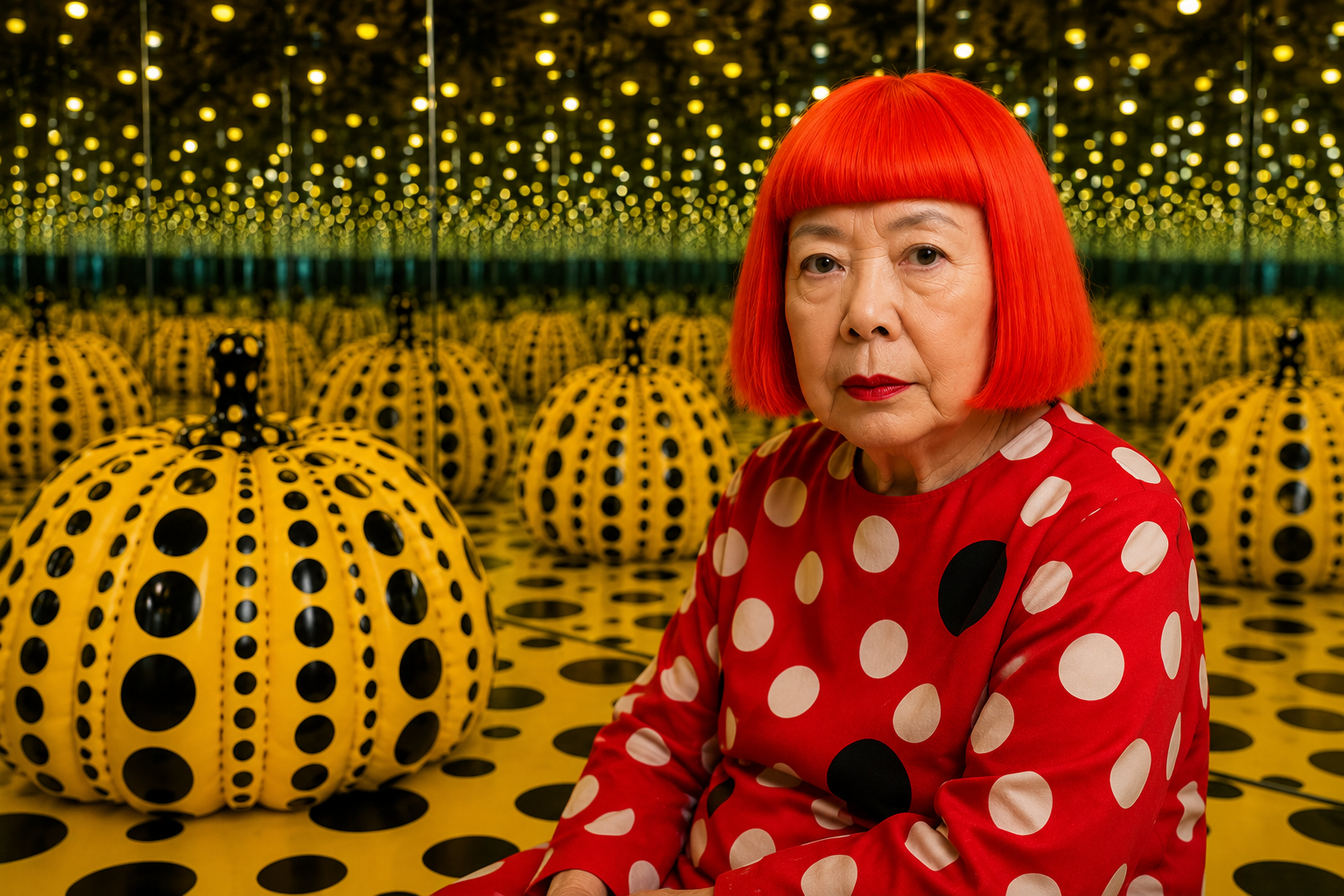
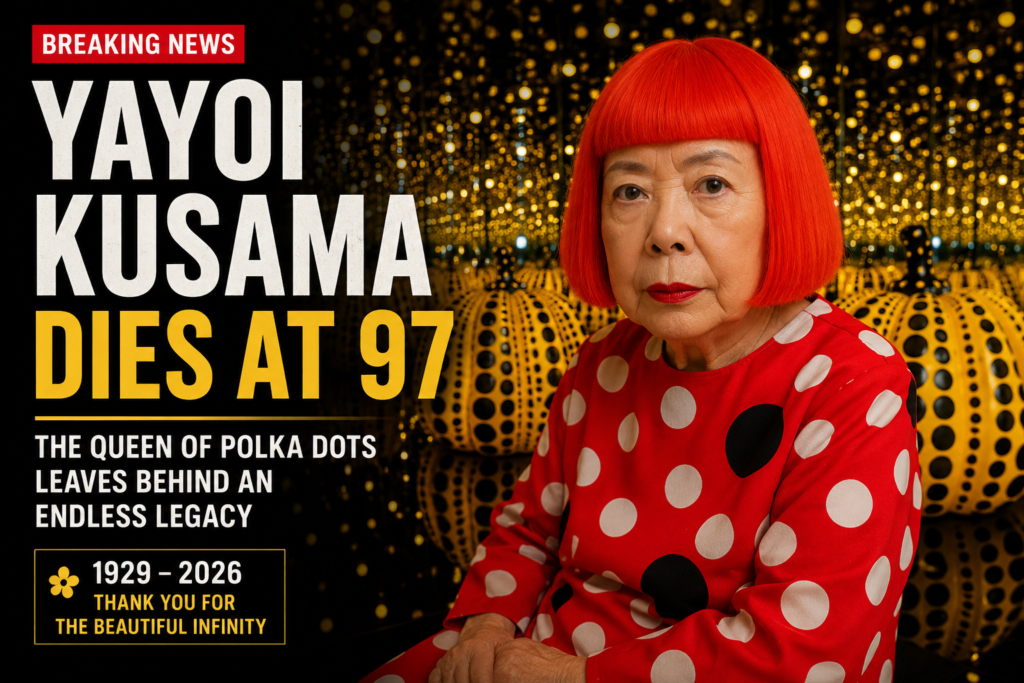
Japanese contemporary artist Yayoi Kusama, one of the most recognizable and influential artists of the modern era, has died at the age of 97. Her studio and foundation announced her passing on August 27, 2026, saying that she died at a hospital in Tokyo on August 14. The cause of death has not been disclosed.
Kusama leaves behind a remarkable artistic legacy spanning more than seven decades. From her famous polka dots and pumpkin sculptures to her mesmerizing Infinity Mirror Rooms, she transformed personal experiences and visions into artwork that attracted audiences around the world.
Yayoi Kusama Dies at 97
The announcement of Kusama’s death has prompted tributes across the international art world. Her official website described her as a pioneering avant-garde artist whose work extended beyond visual art into performance, fiction and poetry. The statement also noted that she continued painting until her final days.
Born on March 22, 1929, in Matsumoto, Japan, Kusama began creating art from a young age. Her distinctive artistic style eventually made her one of Japan’s most internationally celebrated cultural figures.
Her death marks the end of an extraordinary chapter in contemporary art, but her influence is expected to continue for generations.
Who Was Yayoi Kusama?
Kusama became famous for her repeated use of dots, nets, mirrors and infinity motifs. Her work often explored ideas surrounding repetition, self-obliteration, infinity and the relationship between individuals and the universe.
She moved to New York in 1957 and became involved with the city’s experimental art scene. During the 1960s, she created paintings, sculptures and provocative performance works that challenged established ideas about art.
Her early Infinity Net paintings, made from countless repeated marks, helped establish the visual language that would later become synonymous with her name.
The Artist Behind the Polka Dots
For millions of people, Kusama became known simply as the “polka dot queen.”
Her dots appeared on paintings, sculptures, rooms and enormous installations. What initially looked like a simple visual pattern became a much deeper artistic concept.
Kusama used repetition to explore infinity and the feeling of losing oneself within an enormous universe. Her work could be colorful and playful while simultaneously dealing with serious questions about existence and identity.
That combination helped make her art accessible to audiences who might not normally visit contemporary art museums.
Infinity Mirror Rooms Became a Global Phenomenon
Among Kusama’s most famous creations are her Infinity Mirror Rooms.
These immersive installations use mirrors, lights and repeated objects to create the illusion of an endless environment. Visitors appear to see themselves and the surrounding lights continuing forever.
The installations became hugely popular internationally, particularly among younger audiences. Photographs and videos from the rooms spread across social media, introducing Kusama’s work to millions of people who may never have encountered her earlier paintings.
Her ability to turn art into an immersive experience became one of the defining aspects of her later career.
Her Famous Pumpkin Sculptures
Kusama’s pumpkins are another major part of her artistic legacy.
Her brightly colored pumpkin sculptures, covered with distinctive patterns, became instantly recognizable. One of her most famous pumpkins stands on Japan’s art island of Naoshima and became an iconic destination for art lovers.
The pumpkin imagery demonstrated Kusama’s ability to take an ordinary object and transform it into something surreal and memorable.
A Remarkable Return to Global Fame
Kusama’s career was not an overnight success. She experienced periods when her work received limited attention, particularly during her early years in the United States.
Her international reputation grew enormously later in life. Major museums around the world hosted her exhibitions, while collaborations with fashion and commercial brands introduced her distinctive visual style to an even wider audience.
The Yayoi Kusama Museum in Tokyo, which opened in 2017, became another important institution dedicated to her work.
Her official website lists exhibitions connected with her work in 2026, including a planned exhibition at the Stedelijk Museum Amsterdam from September 11, 2026, to January 17, 2027.
Kusama’s Personal Struggles and Art
Kusama openly discussed the hallucinations and psychological experiences that influenced her artistic vision. After returning to Japan in the 1970s, she voluntarily lived in a psychiatric hospital in Tokyo while continuing to work from a nearby studio.
Despite these challenges, she remained remarkably productive.
Her personal experiences became closely connected with her creative process. Rather than allowing difficult experiences to end her career, Kusama repeatedly transformed them into paintings, sculptures, installations and writing.
Her dedication to creating art continued throughout her later years.
A Legacy That Will Live On
Kusama’s influence extends far beyond the traditional art world.
Her visual language has influenced fashion, design, popular culture, museums and digital media. Her exhibitions regularly attracted enormous crowds, demonstrating the extraordinary global appeal of her work.
The National Gallery of Victoria, for example, reported that its Kusama exhibition in Melbourne attracted more than 570,000 visitors, setting an attendance record for the institution.
Her work also achieved significant commercial success. One of her artworks reportedly sold for millions of dollars, reflecting her status among the world’s most valuable contemporary artists.
Tributes Begin Around the World
Following the announcement of her death, museums, galleries, artists and admirers have begun remembering Kusama’s extraordinary contribution to contemporary art.
Her official foundation said that her wishes would be carried forward through art and expressed a desire for her work to continue bringing hope and strength to people around the world.
For many admirers, Kusama’s greatest achievement was not simply creating recognizable artwork. She developed an entirely personal visual language and remained committed to it for decades.
Final Thoughts
Yayoi Kusama’s death at 97 marks the loss of one of the most distinctive voices in contemporary art.
Her polka dots, pumpkins and Infinity Mirror Rooms became global cultural symbols, but her legacy goes much deeper than those recognizable images. Kusama challenged conventional ideas about art, identity and infinity while turning deeply personal experiences into works that could be experienced by millions.
She continued creating until the end of her life, leaving behind an artistic universe that will continue to inspire audiences around the world.
Yayoi Kusama may have left the world at 97, but the infinite world she created through her art is likely to remain with us for generations.