

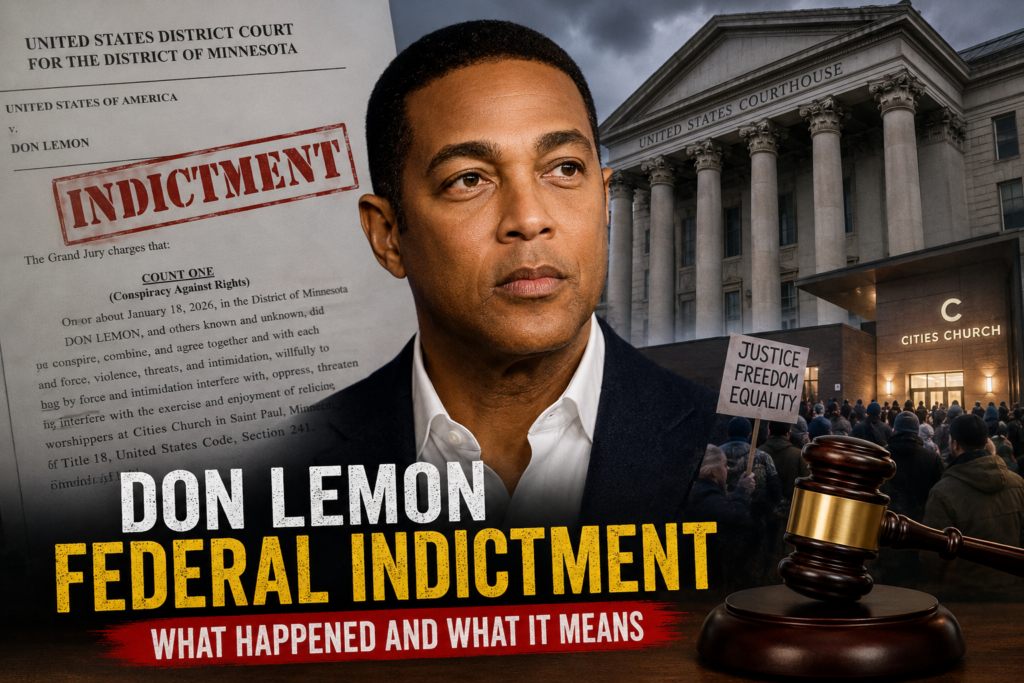
Former CNN anchor and independent journalist Don Lemon is once again at the center of a major legal controversy. His federal indictment in Minnesota has become one of the most closely watched cases involving a journalist in 2026, raising questions about press freedom, protest coverage, federal prosecution and the limits of First Amendment protections.
As of August 25, 2026, the case has taken another important turn. A Minnesota judge has ordered a review of grand jury materials connected to the indictment, adding another layer of uncertainty to a prosecution that has already faced significant legal challenges.
What Is Don Lemon Accused Of?
The case stems from a January 18 protest at Cities Church in St. Paul, Minnesota, during a period of intense demonstrations against federal immigration enforcement.
Lemon was present at the church while covering the protest as a journalist. Federal prosecutors accused him and others of participating in conduct that interfered with worshippers’ religious rights. Lemon has maintained that he entered the church as a reporter and was documenting what was happening.
The indictment included allegations of conspiracy against rights and interference with the exercise of religious freedom. Lemon has pleaded not guilty.
The case also involves the federal Freedom of Access to Clinic Entrances Act, commonly known as the FACE Act. Although the law is widely associated with protecting access to reproductive-health facilities, it also contains protections concerning places of worship.
Why Did Lemon’s Arrest Become Such Big News?
Lemon’s arrest attracted enormous attention partly because of his status as a prominent journalist and former CNN anchor.
Federal authorities arrested him in Los Angeles in late January as he was preparing to cover the Grammy Awards. According to reporting on the case, Lemon’s lawyers have argued that he was willing to surrender voluntarily and that the government’s decision to arrest him was unnecessarily aggressive.
The circumstances surrounding the prosecution have also fueled a broader debate about whether journalists can safely cover demonstrations without becoming criminal defendants themselves.
Lemon’s First Amendment Defense
One of the strongest parts of Lemon’s defense is his argument that his conduct was protected by the First Amendment.
His attorneys say Lemon was performing legitimate journalistic work rather than participating in the protest. They have argued that the government is effectively treating newsgathering as criminal activity.
In August, Lemon’s legal team asked the federal court to dismiss the charges, arguing that the prosecution was vindictive and violated his constitutional rights. His lawyers also challenged the constitutionality of the FACE Act provision being used in the case.
That argument could potentially make the case important beyond Lemon himself.
The Vindictive Prosecution Argument
Another major element of Lemon’s defense is the claim that the prosecution was politically motivated.
His lawyers have pointed to years of criticism and public attacks against Lemon by President Donald Trump and argued that the federal case represents an attempt to punish the journalist for his reporting.
Courts, however, set a high bar for proving vindictive prosecution. Simply demonstrating political hostility or criticism is not necessarily enough to establish that prosecutors brought criminal charges for an improper purpose.
That means Lemon’s legal team faces a difficult challenge, even though the argument has attracted substantial public attention.
Questions About the Grand Jury
The newest development may be one of the most significant.
A Minnesota judge has ordered prosecutors to provide broader grand jury materials for review in connection with the case. The issue is important because grand jury proceedings are normally kept secret, and questions about how the indictment was obtained have become part of the legal dispute.
Earlier proceedings were already unusual. According to reporting, a magistrate judge initially rejected the government’s criminal complaint against Lemon, while subsequent attempts by prosecutors to revive the case faced additional judicial setbacks before a grand jury ultimately returned an indictment.
Lemon’s attorneys have questioned whether prosecutors properly presented evidence to the grand jury.
What Does the Video Evidence Show?
Another important part of the controversy involves video from inside the church.
A Washington Post review reported that footage appeared to contradict some descriptions contained in the federal indictment. The indictment characterized the incident as a coordinated “takeover-style attack,” while video showed Lemon interviewing people at the church and documenting events.
That does not automatically determine whether the charges should be dismissed. A journalist can potentially be present during an unlawful event while still becoming involved in conduct that crosses a legal boundary.
The central question is therefore likely to be whether Lemon was merely reporting on the protest or whether prosecutors can prove beyond the relevant legal standards that he participated in unlawful conduct.
Why the Case Matters for Journalism
The Lemon case has become bigger than one journalist.
Press-freedom organizations have expressed concern that using civil-rights laws against journalists for their reporting could create a dangerous precedent. The Reporters Committee for Freedom of the Press has argued that the government is misapplying federal statutes to criminalize newsgathering activity.
At the same time, prosecutors maintain that the case concerns conduct at a place of worship and the protection of people’s civil rights, rather than simply the act of journalism.
That distinction will likely be crucial as the case develops.
Don Lemon Federal Indictment Review: Our Take
The Don Lemon federal indictment case is difficult to evaluate as a simple political or media story because several legal questions are happening at once.
On one side, the government has an obligation to protect worshippers and enforce federal civil-rights laws. On the other, journalists must be able to report on protests and politically controversial events without automatically becoming participants in the conduct they are covering.
The questions surrounding the grand jury process make the situation even more significant. The judge’s review of the materials could provide additional insight into how prosecutors presented the case and whether the indictment followed proper procedures.
For Lemon, the immediate objective is clear: convince the court that the charges should be dismissed. His defense is relying heavily on First Amendment protections, claims of vindictive prosecution and a constitutional challenge to the FACE Act provision involved in the case.
For the broader media industry, the stakes are much larger. The outcome could influence how journalists approach protests, demonstrations and other contentious events, particularly when federal authorities are involved.
As of August 25, 2026, the case remains unresolved. The grand jury review and Lemon’s dismissal motions could become important milestones in determining what happens next. Until the court reaches a final decision, allegations against Lemon should remain allegations rather than established facts.
One thing is certain: the Don Lemon federal indictment case is no longer simply a story about one former television anchor. It has become a significant test of the relationship between journalism, protest coverage, federal criminal law and constitutional rights.