

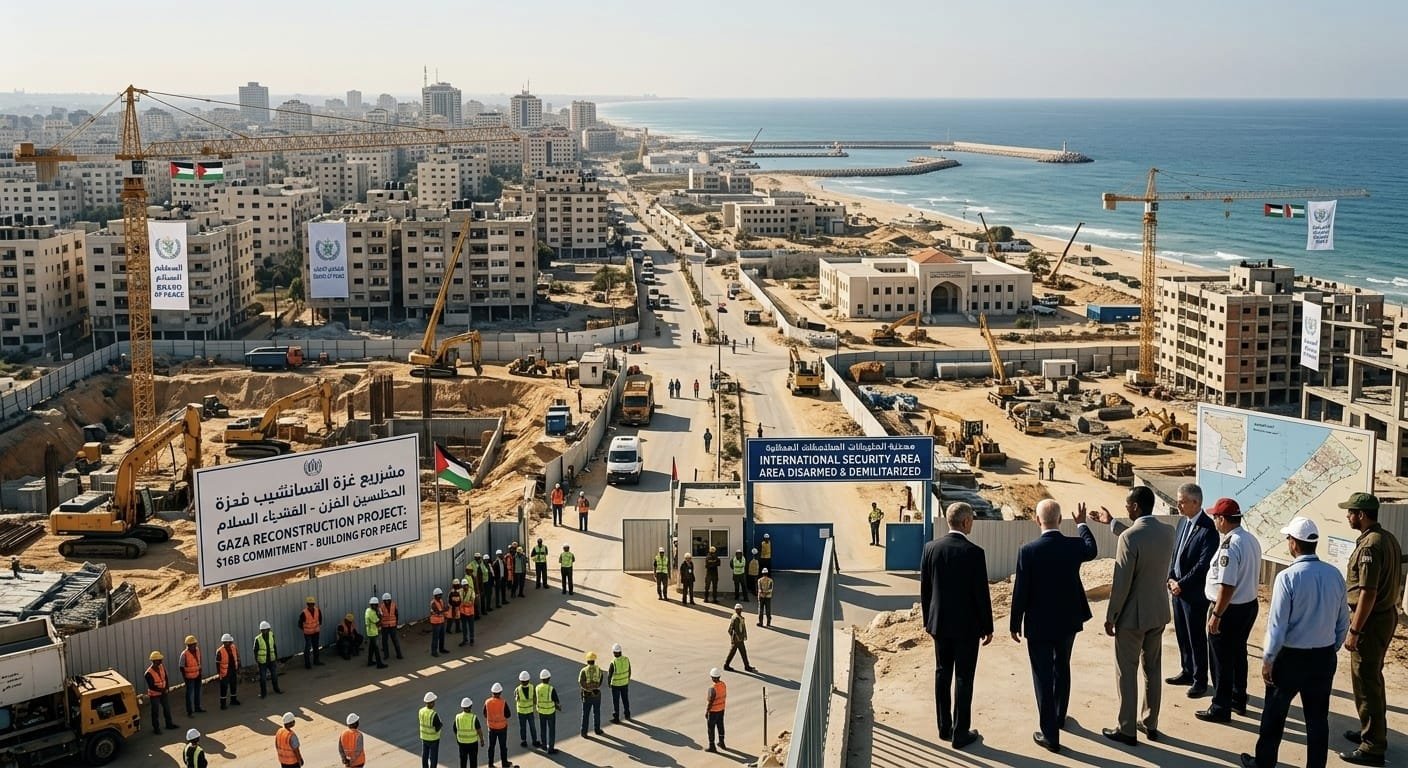
President Donald Trump has announced a major breakthrough in Middle East diplomacy, claiming his U.S.-led Board of Peace has secured a landmark agreement for the complete disarmament of Hamas and other armed factions in the Gaza Strip. Described by Trump as a “monumental step” toward lasting stability, the deal establishes a phased framework where Palestinian militant groups will surrender their arsenals in exchange for a total withdrawal of the Israel Defense Forces (IDF).
Under the newly brokered roadmap, civilian governance and administrative control of Gaza will be handed over to a new technocratic Palestinian authority. This development marks the most significant diplomatic milestone since the initial U.S.-backed ceasefire framework was established in October 2025.
The Core Blueprint: Trump’s 20-Point Plan
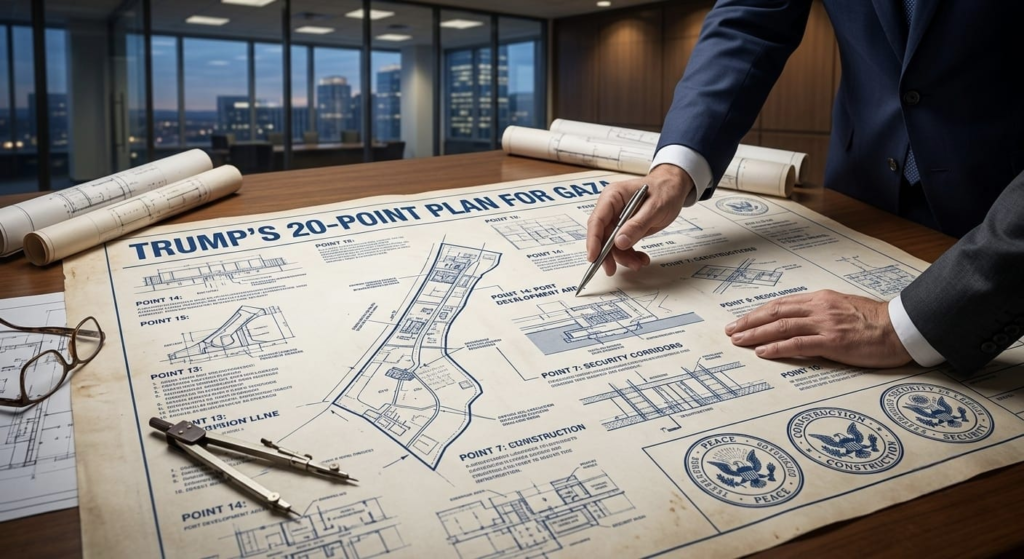
The phased agreement builds directly upon Trump’s 20-Point Plan for post-war Gaza. It addresses the structural vacuum left by over two years of intensive military operations. The framework seeks to transition Gaza from a highly militarized flashpoint into what the administration defines as a “deradicalized, terror-free zone” that no longer poses an existential threat to its neighbors.
TRUMP’S GAZA DISARMAMENT ROADMAP
[PHASE 1: INVENTORY] —> [PHASE 2: STABILIZATION] —> [PHASE 3: COEXIST]
• Catalog stockpiles • Deploy Int’l Force • Grant Amnesty
• Map tunnel systems • Phased IDF Drawdown • Activate $16B Fund
Historically, attempts to negotiate the disarming of Hamas have stalled due to the deeply asymmetric nature of the conflict. However, officials close to the negotiations indicate that the current catastrophic humanitarian crisis affecting more than two million displaced Palestinians prompted the group’s newly elected leadership under Khalil-al-Hayya to accept this unprecedented compromise.
Key Pillars of the Disarmament Roadmap
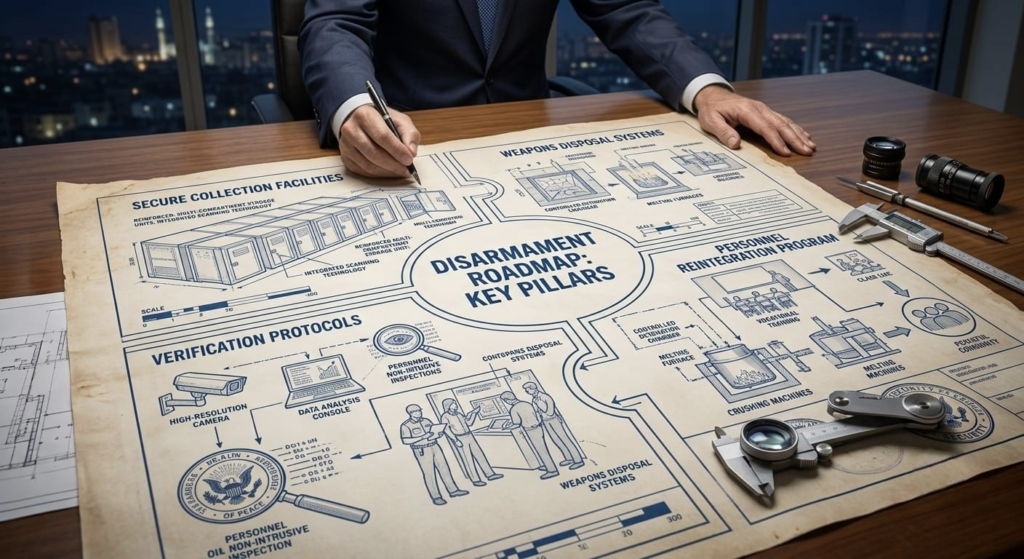
According to the official four-page roadmap released via the U.S. administration, the transition process relies on four tightly coordinated pillars:
1. Complete Demilitarization & Arms Inventory
- Hamas and adjacent armed factions have agreed to a structured framework to log, turn over, and decommission all heavy weaponry. This includes:
- Mid-to-long-range rocket inventories.
- Mortar systems and anti-tank guided missiles (ATGMs).
- Small arms and domestic munitions manufacturing plants.
- The systematic mapping and structural destruction of the remaining subterranean tunnel networks.
2. Phased IDF Withdrawal
The withdrawal of the Israeli military will occur in direct lockstep with verified disarmament milestones. The territory is divided into verification zones. As heavy arms are cataloged and secured in specific sectors, IDF units currently controlling roughly two-thirds of the enclave will retreat toward designated security lines.
3. Technocratic Palestinian Governance
To prevent a political vacuum, civilian administration will be completely decoupled from militant factions. Daily operations, municipal services, border coordination, and civil infrastructure will be managed by the National Committee for the Administration of Gaza (NCAG). Hamas previously dissolved its parallel governance structures to allow this non-political committee of Palestinian technocrats to assume institutional control.
4. International Peacekeeping Presence
Local security will undergo a dual-layered overhaul. An International Stabilization Force, authorized by the UN Security Council and operating under the Board of Peace charter, will deploy to guard key transit corridors and oversee arms depots. This force will work alongside a newly vetted, non-factional Palestinian police force to maintain domestic law and order.
Strategic Comparison: What Each Side Concedes
1. Hamas & Allied Factions
- Key Obligations & Concessions:
- Relinquish all heavy weaponry and military assets
- Dismantle tunnel networks
- Accept technocratic (non-political) civil governance
- Strategic Gains:
- Full cessation of IDF military operations
- Amnesty for members who commit to peaceful coexistence
- Release of designated prisoners
2. Israel
- Key Obligations & Concessions:
- Complete tactical withdrawal from the Gaza Strip
- Release of 250 life-sentence prisoners and 1,700 post–October 7 detainees
- Strategic Gains:
- Verified elimination of Gaza-based rocket threats
- Structural dismantlement of border-adjacent tunnels
- Formalized regional security guarantees
3. United States & Board of Peace
- Key Obligations & Concessions:
- Coordinate the International Stabilization Force
- Ensure compliance and manage verification metrics
- Strategic Gains:
- A major foreign policy achievement
- Stabilization of global trade and maritime routes (especially the Red Sea)
Implementation Challenges and Geopolitical Skepticism
While the Trump administration celebrates this announcement as a monumental diplomatic triumph, regional analysts and military experts urge caution. Transforming a paper agreement into a verified reality on the ground presents massive friction points:
The Weapon Ownership Dilemma
A core point of contention centers on who physically controls the surrendered arms. Senior Palestinian negotiators, including Hamas representative Ghazi Hamad, have explicitly stated they will not hand weapons over to Israeli authorities or external foreign powers. Instead, weapons are slated to be transferred to NCAG-controlled storage facilities under international monitoring. Hamas maintains that actual disarmament remains strictly contingent on Israel stopping all operations and executing its troop withdrawal first.
Israeli Security Preconditions
The Israeli government has maintained a highly cautious stance regarding the current text. Israeli security officials and Defense Minister Gideon Sa’ar have previously labeled partial governance shifts as strategic maneuvers. Israeli leadership insists that 100% verified demilitarization must be executed before any significant troop pullouts occur, arguing that an armed faction will always dictate terms to a civilian government.
THE VERIFICATION DEADLOCK
[ Israeli Stance ]
- Full demilitarization must come first
- Condition: Disarmament before troop withdrawal
[ Hamas Stance ]
- Complete IDF troop withdrawal must come first
- Condition: Withdrawal before disarmament
Timeline and Operational Scale
The agreement dictates that a precise, formalized disarmament roadmap must be completed within a rigid 14-day window. However, U.S. and international officials, including Board of Peace envoy Nickolay Mladenov, openly acknowledge that the practical execution of the deal—cataloging deep tunnel networks, securing munitions, and clearing debris—is an immense operational task that could take between 200 to 350 days to fully implement.
Funding a $16 Billion Reconstruction Era
Should the International Verification Committee (IVC) successfully certify the initial disarmament milestones, the agreement unlocks an unprecedented economic package for the region. A coalition of international donors, spearheaded by the United States and several Gulf nations, has organized a $16 billion reconstruction fund.
This fund is structurally tied directly to the verification process. Money will not be disbursed in a lump sum; rather, capital will be released in tranches to the NCAG as specific security benchmarks are met. The reconstruction blueprint targets three primary sectors:
1.Critical Infrastructure Restoration: Rebuilding shattered electrical grids, deploying large-scale desalination plants to restore safe drinking water, and clearing millions of tons of conflict debris.
2.Civilian Housing and Urban Renewal: Transitioning over a million internally displaced persons out of temporary tent cities and into newly designed, master-planned residential communities.
3.Economic Integration: Developing commercial zones along transit borders and upgrading port infrastructure under international maritime oversight to foster long-term economic self-sufficiency.
The Broader Middle East Impact
The implications of the Board of Peace initiative extend far beyond the borders of Gaza. If successful, this framework completely reshapes the geopolitical dynamics of the Levant:
- De-escalation of Regional Flashpoints: A permanent resolution in Gaza severely dampens the operational pretext for cross-border conflicts involving adjacent state and non-state actors throughout the region.
- Protection of Global Maritime Trade: The stabilization of the Levant directly correlates with eased tensions along vital maritime corridors, supporting initiatives like the Saudi-led maritime alliance protecting trade lanes.
- A New Precedent for International Administration: The Board of Peace—operating with specific executive authority authorized through historical UN Security Council resolutions—presents a stark departure from traditional UN-only peacekeeping models, offering a hybrid public-private diplomatic alternative.
Final Thoughts: A Fragile Window of Opportunity
The Board of Peace agreement represents arguably the most comprehensive technical framework ever drafted to resolve the core security dilemmas of the Gaza Strip. For the first time, a concrete link has been established between the complete demilitarization of militant factions and a total withdrawal of occupying forces, backed by billions in verified reconstruction capital.
Yet, in the Middle East, a plan is only as strong as its verification mechanisms. With deep historic distrust between the primary actors, the coming weeks will determine whether this roadmap serves as the foundation for an enduring peace or yet another historical near-miss.
💬 What’s Your Perspective?
Do you believe the Board of Peace can successfully enforce this aggressive disarmament timeline on the ground? Can international peacekeepers maintain order where decades of conventional diplomacy have faltered?
Join the conversation in the comments section below and share this article with your network to keep the discussion going.